Halloween 2026: the theme wore out, not the cards
For most of the run-up to Halloween 2026, Antics dealt Halloween cards into its party games automatically, whether a group was at a Halloween party or not. We looked at how groups played them, then changed how the app deals seasonal cards. Here’s what we found.
Published 7 November 2026
The short version
- 12.2%Of a group’s first three Halloween cards in Never Have I Ever got skipped. Everyday cards: 12.4%
- 1 in 3Halloween cards skipped from a group’s ninth on in Never Have I Ever and Most Likely To. First three: 11% to 12%
- About 2×As often skipped as everyday cards when dealt into every night (Never Have I Ever and Most Likely To)
- 3.2%Of Halloween truths got skipped. Everyday truths: 6.0%
- 1.5×As long an Imposter round with the Halloween words as with the everyday decks
- 1 in 8Seasonal cards now, and only when a group switches them on
The first Halloween cards held their own
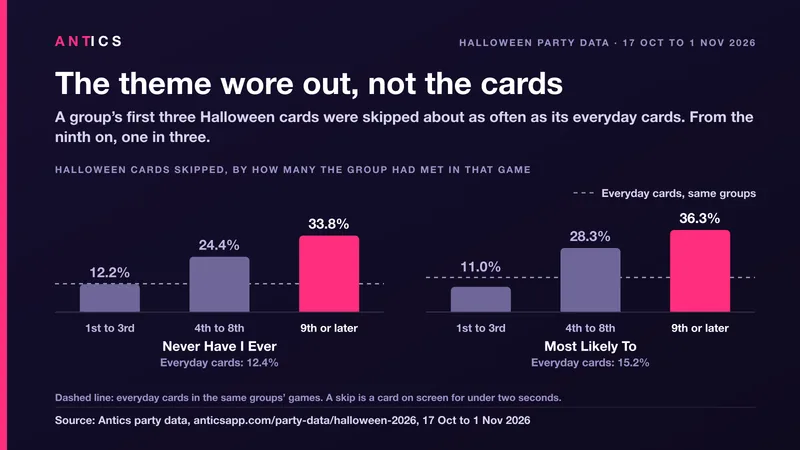
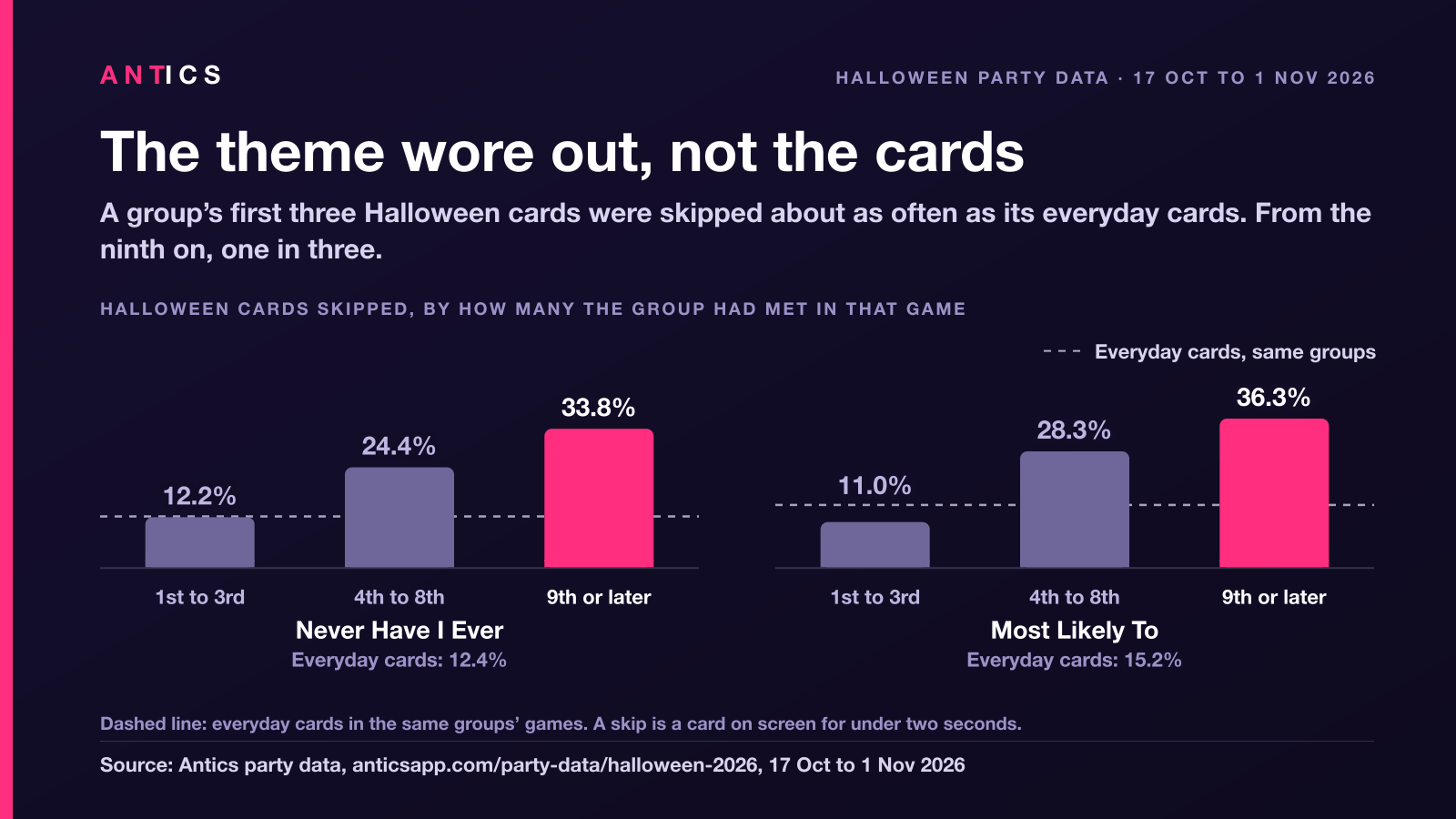
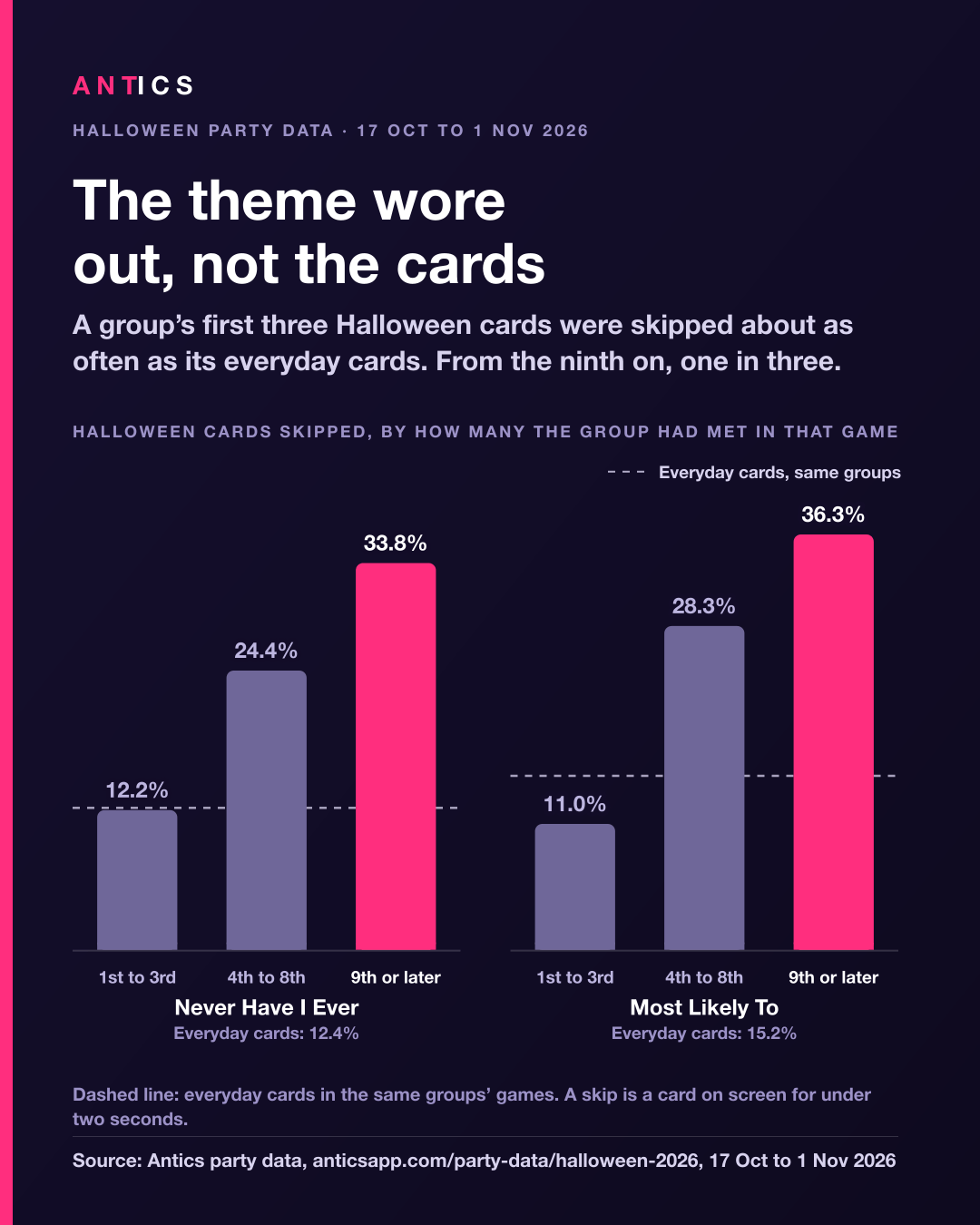
In Never Have I Ever and Most Likely To, the two games where groups met the most Halloween cards, a group’s first three Halloween cards in a game were skipped about as often as its everyday cards: 12.2% against 12.4% in Never Have I Ever, and 11.0% against 15.2% in Most Likely To.
On their own, Halloween cards were not the problem. Meeting them again and again was.
Then the theme wore out
Skips rose with every Halloween card a group met. From its fourth to its eighth, about a quarter were skipped (24.4% in Never Have I Ever, 28.3% in Most Likely To). From the ninth on, about a third (33.8% and 36.3%).
| Card | Bar | Skipped |
|---|---|---|
| 1st to 3rd Halloween card | 12.2% | |
| 4th to 8th | 24.4% | |
| 9th or later | 33.8% | |
| Everyday cards, same groups | 12.4% |
| Card | Bar | Skipped |
|---|---|---|
| 1st to 3rd Halloween card | 11.0% | |
| 4th to 8th | 28.3% | |
| 9th or later | 36.3% | |
| Everyday cards, same groups | 15.2% |
It wasn’t just the late hour. In the groups that met the most Halloween cards, everyday cards were skipped a little more as the night went on too, by about 5 points, while Halloween cards rose by about 20. Groups didn’t tire of the game. They tired of Halloween.
Costumes show it most clearly. A group’s first costume card was skipped 8.3% of the time; from its sixth on, 30.7%. Repetition, not the costume.
Positions count within one game: a group’s ninth Halloween card in Never Have I Ever is its ninth in that game, not its ninth of the night. Everyday cards are every other card dealt in the same groups’ games across the window. The everyday and Halloween comparison through the night comes from the free version of each game.
Dealt into every night, Halloween cards were skipped twice as often
Add up the whole window and the cost of forcing a theme shows. In Never Have I Ever and Most Likely To, Halloween cards were skipped about twice as often as everyday cards in the same groups’ games: 25.2% against 12.4%, and 28.1% against 15.2%. About three in five of those Halloween skips came from a group’s ninth Halloween card or later.
Skipped didn’t mean stopped. In Never Have I Ever, 4.9% of Halloween cards were the last card before a group left the game, against 4.7% of everyday cards; in Most Likely To and Would You Rather the gap was under 1.5 points. Groups flicked past and played on.
The figures for the last card before a group left the game come from the free version of each game.
In Truth or Dare, the theme cost nothing
Halloween truths were skipped 3.2% of the time, against 6.0% for everyday truths in the same groups’ games. Halloween dares were hardly ever skipped, just like everyday dares (3.6% and 2.4%).
Among Halloween truths dealt often, the ones never skipped were mostly questions about someone in the room. A question about the people sitting right there works in any season.
Imposter liked the Halloween words
In Imposter, where every player but one gets the same secret word, rounds with the Halloween word deck lasted about half as long again as rounds with the everyday decks in the same groups’ games, and groups went on to play another round at least as often. A spooky word gives the room more to argue about.
Imposter deals rounds, not cards, and far fewer of them, so read its figures as a direction.
What we changed
So we stopped forcing it. Since Antics 1.1.4, out on 29 October 2026, seasonal cards are an add-on: a group switches them on with one tap in the game’s lobby, and then one card in eight is seasonal, not one in four. This Christmas is the first season dealt that way from the start.
It comes straight from the data. The first few seasonal cards a group meets are skipped no more than its everyday cards; it is the later ones that wear thin. So they now go to the groups that ask for them, and come less often, so the theme lasts the night.
How we counted
- Window
- 17 October to 1 November 2026, the days Halloween cards were in the app, read on 6 November 2026.
- Source
- Antics’ own anonymous in-app analytics, from App Store and Google Play versions only. Phones on TestFlight, Google Play internal testing or a development build, and anything played in a web browser, are left out. The app never records names, typed text or anyone’s answers.
- A skip
- A card on screen for under two seconds. Runs of five or more quick flicks in a row are scrolling and are left out.
- Like with like
- Halloween cards are compared with everyday cards in the games of the same groups: every group that met at least one Halloween card in that game. Groups differ a lot in how fast they play, so this keeps the comparison fair.
- How the cards were dealt
- Until 29 October (Antics 1.1.3), the app dealt Halloween cards automatically: one card in four, and more often in the free version, whether a group wanted the theme or not. From 29 October (1.1.4), they were an add-on a group switches on. Almost every Halloween card in these figures was dealt the automatic way.
- How sure we are
- In Never Have I Ever and Most Likely To, the gap between Halloween and everyday cards over the window and the rise with each Halloween card a group met are well beyond chance, and so is the rise for costume cards. Differences between one Halloween card and another are within what chance alone could produce, so we don’t rank single cards.
- What it can’t tell you
- How Halloween cards play at a party that chose the theme. By Halloween weekend most groups were on 1.1.4, where the theme is a choice, and the window closed before there was enough of that play to measure. This Christmas is the first real test.
Use this data
Journalists, student media and bloggers are welcome to use these numbers. They’re free to use under CC BY 4.0: please credit Antics and link to this page. A ready-made chart is below.
Source: Antics party data, Halloween 2026, 17 October to 1 November 2026.
Download the chart
The chart comes as a landscape image for an article and a portrait one for a social post, with the source set into the image. Every figure on it is on this page.
Free to use with a link to anticsapp.com/party-data/halloween-2026.
-
 The theme wore out, not the cards
Landscape PNG, 1600 x 900 (74 KB)
Portrait PNG, 1080 x 1350 (74 KB)

See what your group skips
A party game app for iPhone and Android. Nine games, thousands of cards, no ads.
App Store Google Play
On a laptop? Point your phone camera here.